
Short answer: a 1.2 m LED tube PCB cannot be loaded or unloaded by a standard-magazine machine. The largest loader in the standard family, the SLD460, is published with a maximum PCB size of 530 x 460 mm, while a 1.2 m tube board is 1200x350 mm - over twice the length. Southern Machinery covers this class with the SLD350L magazine loader and SUL350L magazine unloader: both rated for a Max PCB size of 1200x350 mm on a 1200*460*563 mm magazine rack, on frames of 2800*970*1250 mm (loader) and 3000*970*1250 mm (unloader), each weighing 300KG. Every figure in this article is quoted from the official product PDF 1.2M LED PCB Magazine loader unloader (6 pages, 2022-07-02), linked in Downloads.
Where the standard magazine loader family stops
Magazine loaders and unloaders are dimensioned around the magazine, not around the line. Each model in the standard family is published against a board envelope that follows its magazine width class, and the numbers below are quoted from each model's own product page:
| Model | Function | Published PCB envelope (min - max) | Source page |
|---|---|---|---|
| SLD250 | Magazine loader | 50x50 - 330x250 mm | SLD250 product page |
| SLD330 | Magazine loader | 50x50 - 445x330 mm | SLD330 product page |
| SLD460 | Magazine loader | 50x50 - 530x460 mm | SLD460 product page |
| SUL-250 | Magazine unloader | 50x50 - 330x250 mm | SUL-250 product page |
| SUL-390 | Magazine unloader | 50x50 - 530x390 mm | SUL-390 product page |
| SUL460 | Multi-magazine unloader | 2 magazines (upper 1, lower 1), 50 pcs storage | SUL460 product page |
Important: the limits in this table belong to the SLD250 / SLD330 / SLD460 / SUL models and are quoted from their own pages. They are not SLD350L or SUL350L data and must not be mixed with the long-board specification below.
Why a 1200 mm board changes the machine, not just the slot
Three things break at once when the board length leaves the 500 mm class:
- The magazine itself. The long-board pair runs on a 1200*460*563 mm rack - the length dimension follows the board, so the magazine, its guide rails and the frame that carries it all grow with it. The antistatic magazine slots are shown below.
- Where the board is pushed from. On a short board the pusher acts near the magazine wall; on a 1.2 m board the centre of the stack is far from that wall, which is why the SUL350L data sheet lists "Pusher position adjustable to centre of the magazine" and "Regulated pressure on attached pneumatic pusher" as features rather than options, and why the SLD350L lists "Pneumatic clamps provided for magazine alignment" alongside a regulated pusher pressure.
- The transport table. A 1200 mm board leaves the magazine with most of its span unsupported, so the conveyor section has to be long enough to carry it to the next process. That is what the 2800 mm (loader) and 3000 mm (unloader) machine lengths are buying, and what the installed photos in this article show.
SLD350L and SUL350L: the published specification
Every value in this table comes from the same official document, page by page. Where the loader page of the PDF does not state a figure, it is marked "not stated" rather than filled in from the unloader or from a sibling model.
| Parameter | SLD350L (loader) | SUL350L (unloader) | Source |
|---|---|---|---|
| Function | Loading of PCBs from the production line | Unloading of PCBs from the production line | PDF p.1 / p.2 Description |
| Max PCB size | 1200x350 | 1200x350 | PDF p.1 / p.2 spec table |
| Dimension (L*W*H.MM) | 2800*970*1250 | 3000*970*1250 | PDF p.1 / p.2 spec table |
| Weight(KG) | 300KG | 300KG | PDF p.1 / p.2 spec table |
| Rack size (L*W*H.MM) | 1200*460*563 | 1200*460*563 | PDF p.1 / p.2 spec table |
| Magazine quantity | not stated | upper 1pc, bottom 1pc | PDF p.2 Features |
| Magazine changeover | "High throughput with short magazine change-over time" (no figure stated) | "Tank Replacement time: about 30 seconds or specify" | PDF p.1 / p.2 Features |
| Step select | not stated | 10, 20, 30, 40 mm or specify | PDF p.2 Features |
| Power | not stated | 110V or 220V, single phase max 250VA | PDF p.2 Features |
| Air pressure | not stated | "Barometic pressure from 4-6 bar, up to 10/min" | PDF p.2 Features |
| Pusher | Pneumatic pusher pressure regulated | Regulated pressure; position adjustable to centre of the magazine | PDF p.1 / p.2 Features |
| Magazine alignment | Pneumatic clamps provided for magazine alignment | not stated | PDF p.1 Features |
| Control panel | User friendly "soft touch" LED membrane control panel | User friendly "soft touch" LED membrane control panel | PDF p.1 / p.2 Features |
| Line interface | SMEMA compatible | SMEMA compatible | PDF p.1 / p.2 / p.3 |
| Construction | Stainless steel material; antistatic magazine | Stainless steel material; antistatic magazine | PDF p.3 Quick details |
| Frame design | Sturdy and stable design | Sturdy and stable design | PDF p.1 / p.2 Features |
Two numbers the source does not give. The PDF states no boards-per-hour throughput and no cycle time for either model, so none is published here; the loader page says only "High throughput with short magazine change-over time". The "up to 10/min" that appears on the unloader page is quoted verbatim in the air-pressure line exactly as the document writes it, and is not reinterpreted. Confirm both points with our engineers against your board mix before sizing a line.
Installed: what the long-board station actually looks like
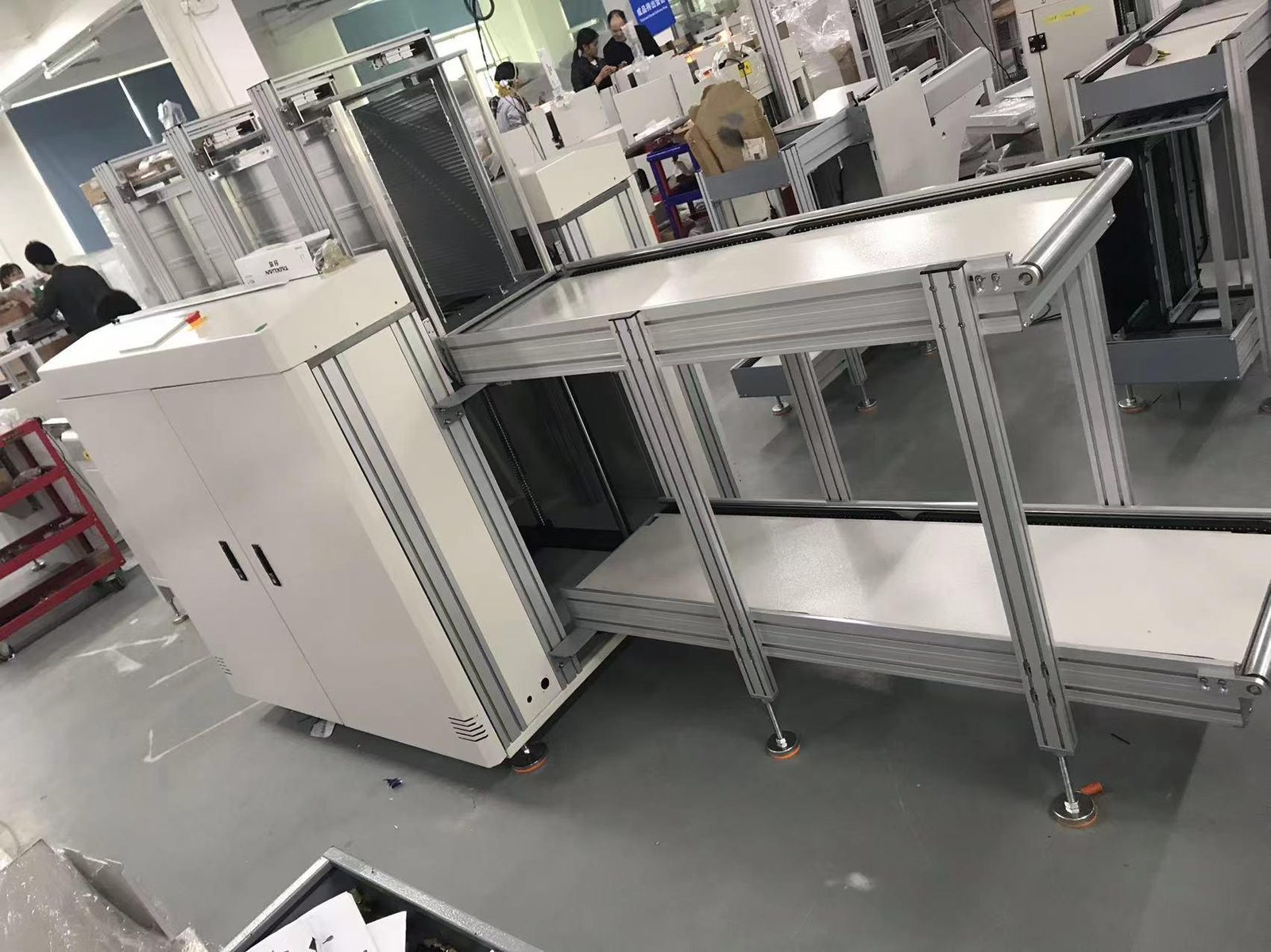
SLD350L magazine loader for 1200x350 mm boards: cabinet, magazine station and the long conveyor table that carries the unsupported span. Photo from the official product PDF (p.1).
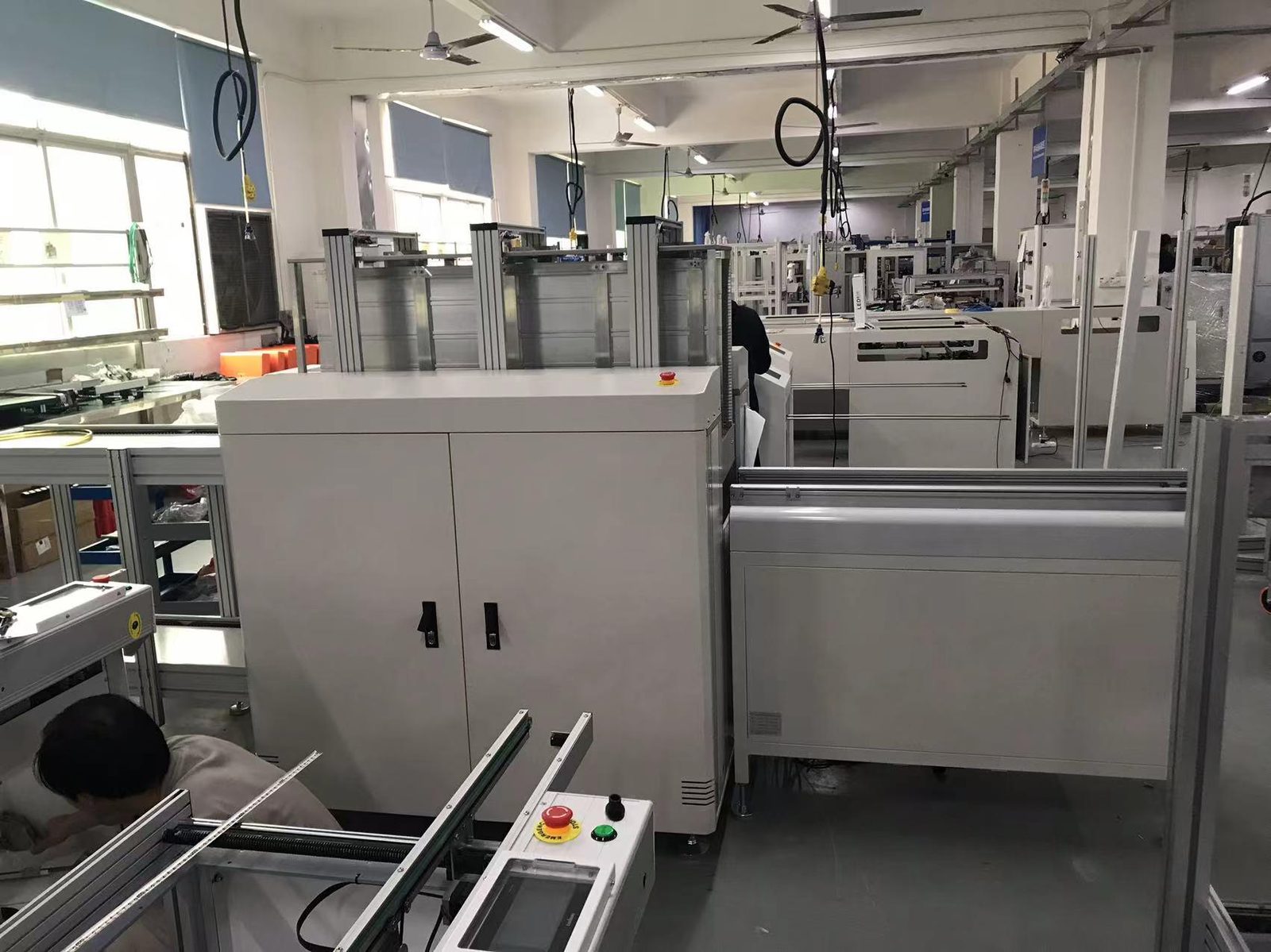
SUL350L magazine unloader installed in an EMS factory, with the soft-touch LED membrane control panel at the operator edge. Photo from the official product PDF (p.2).
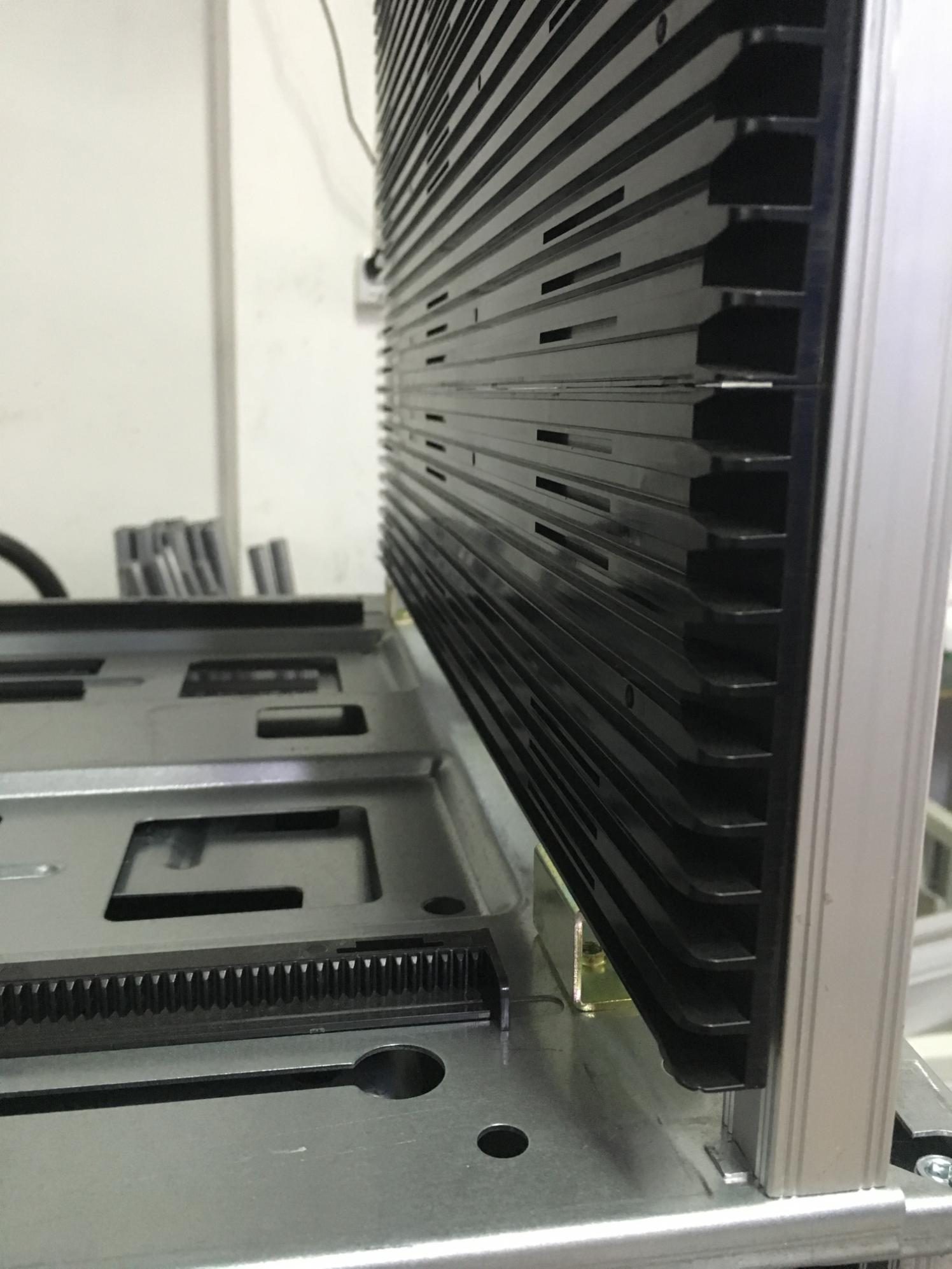
The antistatic magazine: slot pitch and stack depth are what set the step-select values (10, 20, 30, 40 mm or specify). Photo from the official product PDF (p.3).
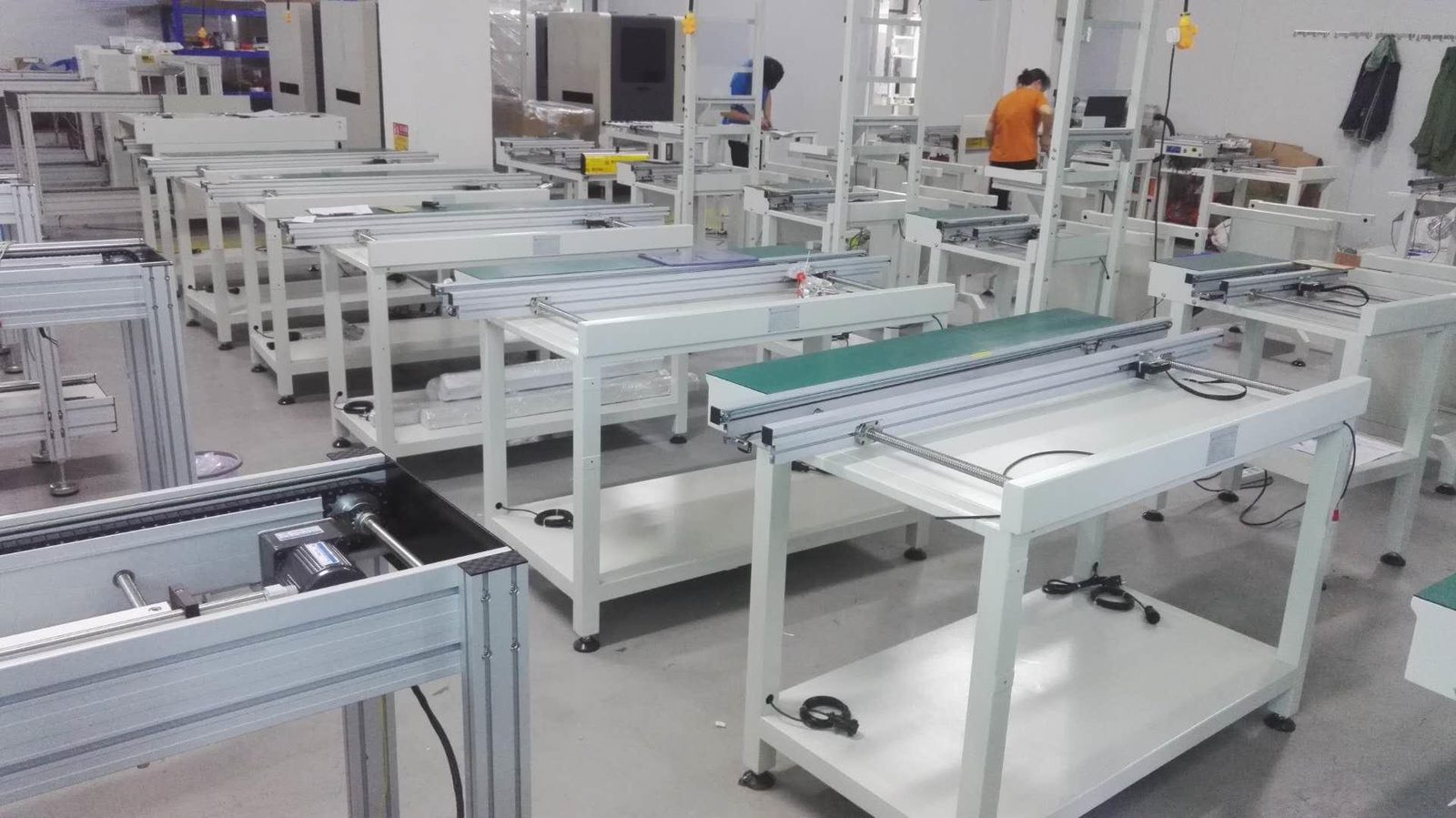
A 1.2 m LED tube line layout, showing where the loader and unloader sit relative to the long conveyor sections. Photo from the official product PDF (p.4).
Changeover, step select and the magazine as a logistics unit
The unloader is the model where the source document is explicit: one magazine upper, one magazine lower, a tank replacement time of about 30 seconds or specify, and step select of 10, 20, 30, 40 mm or specify. Those three lines are the practical reason a long-board line keeps running: the magazine, not the machine, is the unit that gets swapped, and the board pitch is set by the magazine you load into it.
Because the rack is a 1200*460*563 mm object, it also has to move around the factory between the loader, the unloader and the storage area. That is the same problem the magazine-transport robots solve on shorter boards - see AGV Robot for Moving PCBs in Factory and SMT AGV for Material Delivery SAGV0601.
Integration: SMEMA, ESD and the downstream LED process
Both models are listed as SMEMA compatible, which is what lets a long-board loader or unloader sit on an existing SMT or DIP line without a bespoke handshaking layer. The stainless steel frame and antistatic magazine (PDF p.3) matter specifically for LED tube assembly, where the boards are long, light-sensitive and often handled by more manual stations than a conventional SMT product.
The 1.2 m class does not stop at loading. Lens mounting, gang pick and place and the final depanelising step are all length-limited processes, which is why the same document family also covers the separator stage - see S-D502 LED Tube Separator with long platform and LED lights PCB separator in surface mount technology. For the whole-factory view rather than the single station, read How to build one new LED Bulb/Tube Light factory.
See it running
1.2M LED tube lighting PCB Lens mounting application for Smart EMS factory PCB assembly
AGV to transport PCB magazine loader unloader for Smart EMS factory PCB assembly
PCB magazine loader working for EMS
LED 1.2m tube MC PCB separator
Checklist before you specify a long-board loader
- Board envelope first. Measure the finished panel, not the design file. The published ceiling for this pair is 1200x350 mm; anything longer is a custom conversation, not a catalogue order.
- Magazine, then machine. Confirm the rack size (1200*460*563 mm) against the magazines you already own, and choose the step select (10, 20, 30, 40 mm or specify) from your slot pitch.
- Utilities. The unloader is stated at 110V or 220V single phase, max 250VA, with air from 4-6 bar. Confirm the loader's supply figures with us - the source document does not state them.
- Changeover maths. Use the stated about 30 seconds tank replacement, then multiply by your magazine moves per shift - that is where long-board lines lose or win time.
- Handshake. SMEMA compatibility covers the line interface; still verify conveyor height and direction with the adjacent equipment.
- Transport. A 1.2 m magazine needs a handling plan of its own - see the AGV links above.
After-sales terms published for this product family: worldwide support, free installation and training, 1 day lead-time (spare parts) and a 1 Month customize solution (PDF p.5).
Frequently asked questions
What is the maximum PCB size of the SLD350L?
1200x350 mm, per the specification table on page 1 of the official 1.2M LED PCB Magazine loader unloader document. The SUL350L unloader carries the same 1200x350 mm rating.
Can a standard SLD460 magazine loader handle a 1.2 m LED tube board?
No. The SLD460 page publishes a PCB envelope of 50x50 - 530x460 mm, so a 1200 mm board is more than twice the length it is built for. The 1.2 m class needs the SLD350L / SUL350L frame, magazine and pusher arrangement.
How long does a magazine change take?
The unloader document states a tank replacement time of about 30 seconds, or as specified. For the loader, the document says only that it delivers high throughput with a short magazine change-over time, without publishing a figure.
What air and power supply is required?
The unloader is specified at 110V or 220V single phase, max 250VA, with barometric pressure from 4-6 bar (the document adds "up to 10/min" in the same line). Power and air figures for the loader are not stated in the source document.
Will it drop into an existing SMT line?
Both models are listed as SMEMA compatible, with a user friendly soft-touch LED membrane control panel. Conveyor height and flow direction still need checking against the adjacent equipment.
Is there a published throughput in boards per hour?
No. The source document does not state a boards-per-hour or cycle-time figure for either model, so we do not publish one. Ask us for a line study against your board mix.
What magazine does it use?
A 1200*460*563 mm rack, antistatic, on a stainless steel machine frame. The unloader holds one magazine upper and one lower.
Downloads and related reading
- 1.2M LED PCB Magazine loader unloader (official product PDF, 6 pages) - the single source for every SLD350L / SUL350L figure on this page.
- SLD460 SMT PCB Magazine Loader - the largest standard-family loader, for comparison.
- SLD330 and SUL-390 - the mid-range magazine pair.
- How to build one new LED Bulb/Tube Light factory - the whole-line view.
- 6 Months ROI for LED T8 assembly - LED tube automation economics.
- AGV Robot for Moving PCBs in Factory - magazine transport between stations.
- Questions: info@smthelp.com or Southern Machinery contact.
Source and review note: all SLD350L / SUL350L values on this page are quoted from the official Southern Machinery document "1.2M LED PCB Magazine loader unloader" (6 pages, dated 2022-07-02), mirrored publicly at file.autoinsertion.com and checked against our local copy on 2026-09-30. The SLD250 / SLD330 / SLD460 / SUL-250 / SUL-390 / SUL460 envelope figures are quoted from each model's own smthelp.com product page and are deliberately kept separate from the long-board specification. The four photographs are extracted from the same official PDF - real installed equipment, no AI-generated imagery. Video titles were verified against YouTube oEmbed on 2026-09-30. Figures the source document does not state (loader power and air, throughput, cycle time) are marked as not stated rather than estimated.