
Answer first: the four readings and what each one authorises you to change
The service document lists four instruments and, for each, the condition that means a consumable is finished. Reproduced below as published, with the source named in the last column.
| # | Panel instrument | Value as published | What it means when it is out of range | Source |
|---|---|---|---|---|
| 1 | RO pressure Meter | average working value range should be 0.6 - 1Mpa | outside that range means the RO membranes need to be changed | DI-1000 consumable materials issues .pdf |
| 2 | Tap Water Pressure Meter | should be >0.1 Mpa | otherwise the alarm of "Tap Water Pressure Low" will flash, and you need to check the tap water pressure and flow | DI-1000 consumable materials issues .pdf |
| 3 | Conductivity | should be <10 (the document prints no unit on this reading) | otherwise both the softening resin and the activated charcoal need to be changed | DI-1000 consumable materials issues .pdf |
| 4 | Resistivity | normal value range is >10 (no unit printed); valid only while the "DI Pump on" lamp is lit | otherwise the two tanks of polishing resin need to be changed | DI-1000 consumable materials issues .pdf |
Two of those four are pressure readings in megapascals and are unambiguous. The other two are panel instrument readings that the document prints as bare numbers - it does not attach µS/cm to the conductivity figure or MΩ·cm to the resistivity figure. They are quoted here exactly as printed, as a panel reading, because converting them into assumed units would be inventing a specification the source does not contain.
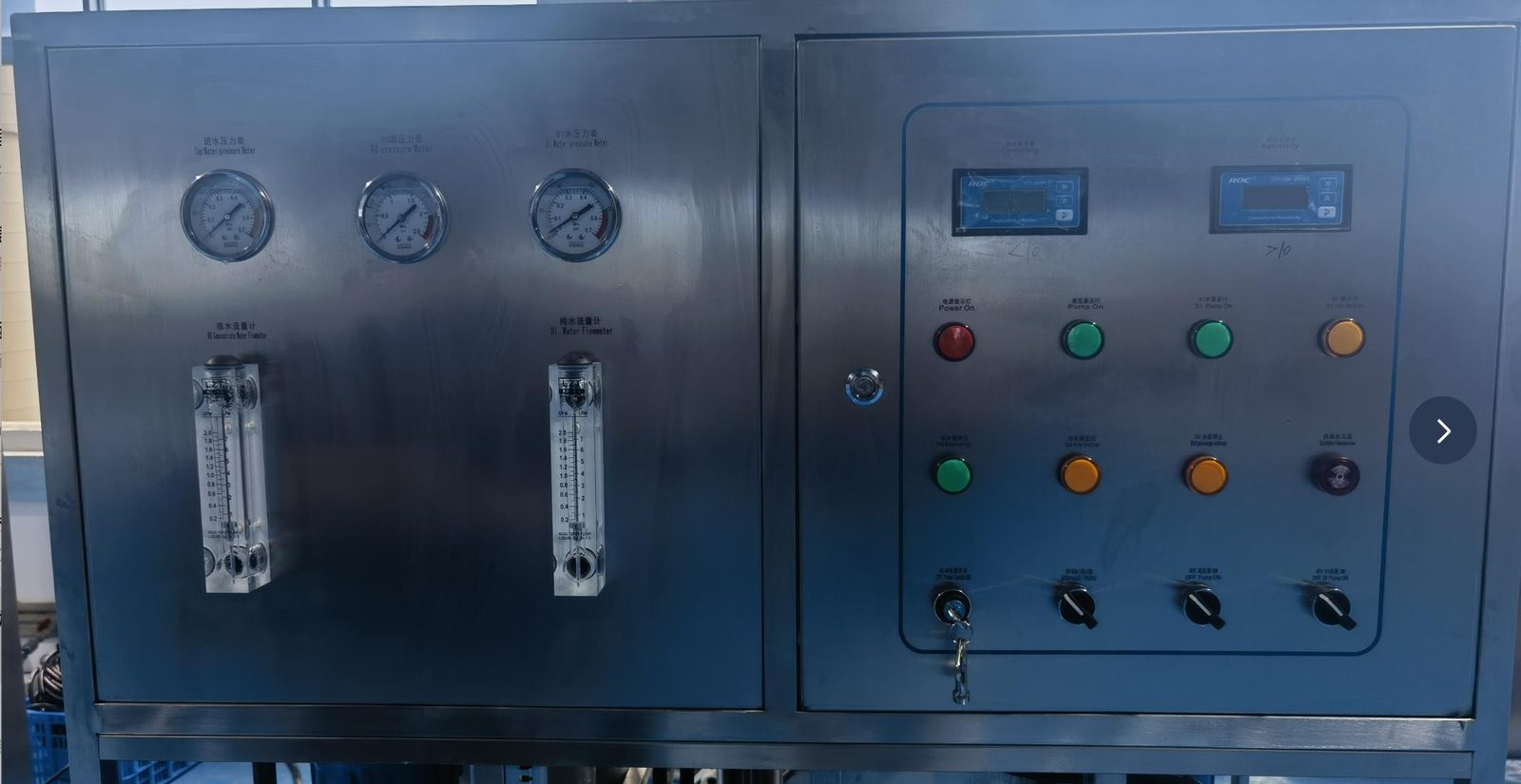
The whole diagnosis lives on this panel: three gauges upper left, two flow meters below them, and the conductivity / resistivity monitors on the right. Photograph from DI-1000 consumable materials issues .pdf.
Reading 1 - RO pressure meter: 0.6 - 1Mpa
The RO pressure meter is the gauge that speaks for the reverse osmosis membranes. The document states the average working value range as 0.6 - 1Mpa and says plainly that a reading outside that range means the RO membranes need to be changed.
This is a range, not a pass/fail line, and the distinction matters on a shop floor. A gauge creeping up out of the range and one that has fallen below it are both "out of range", but they are usually caused by different things; the document does not attempt that split, so neither does this article. What it does give you is a defensible reason to stop arguing about membrane age in months and start arguing about a number you can read without opening the cabinet.
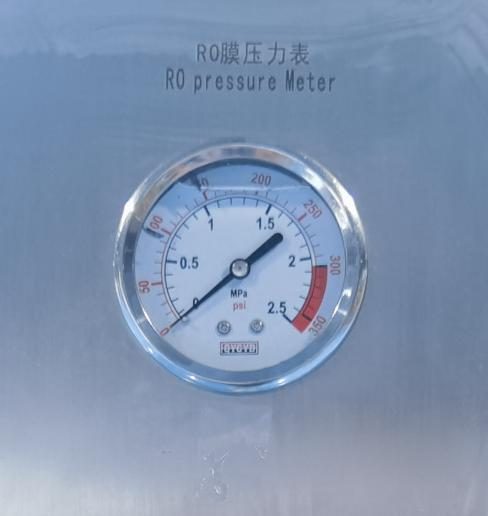
The gauge is labelled bilingually on the panel as "RO pressure Meter". Photograph from DI-1000 consumable materials issues .pdf.
Reading 2 - Tap water pressure meter: above 0.1 Mpa
The second instrument is not really about water quality at all - it is about supply. The value of the tap water pressure meter should be above 0.1 Mpa; otherwise the alarm "Tap Water Pressure Low" will flash, and the instruction is to check the tap water pressure and flow.
Worth separating in your own maintenance log, because it is the one of the four that is frequently not the machine's fault. A plant that has added a second line, a new rinse station or a compressor drawing from the same header can trip this alarm with perfectly healthy resin in the tanks. Replacing consumables in response to a supply-side alarm is how a team burns a set of cartridges for nothing.
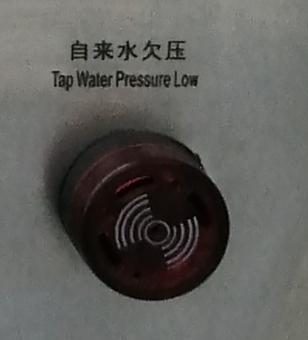
The "Tap Water Pressure Low" beacon, as shown in DI-1000 consumable materials issues .pdf.
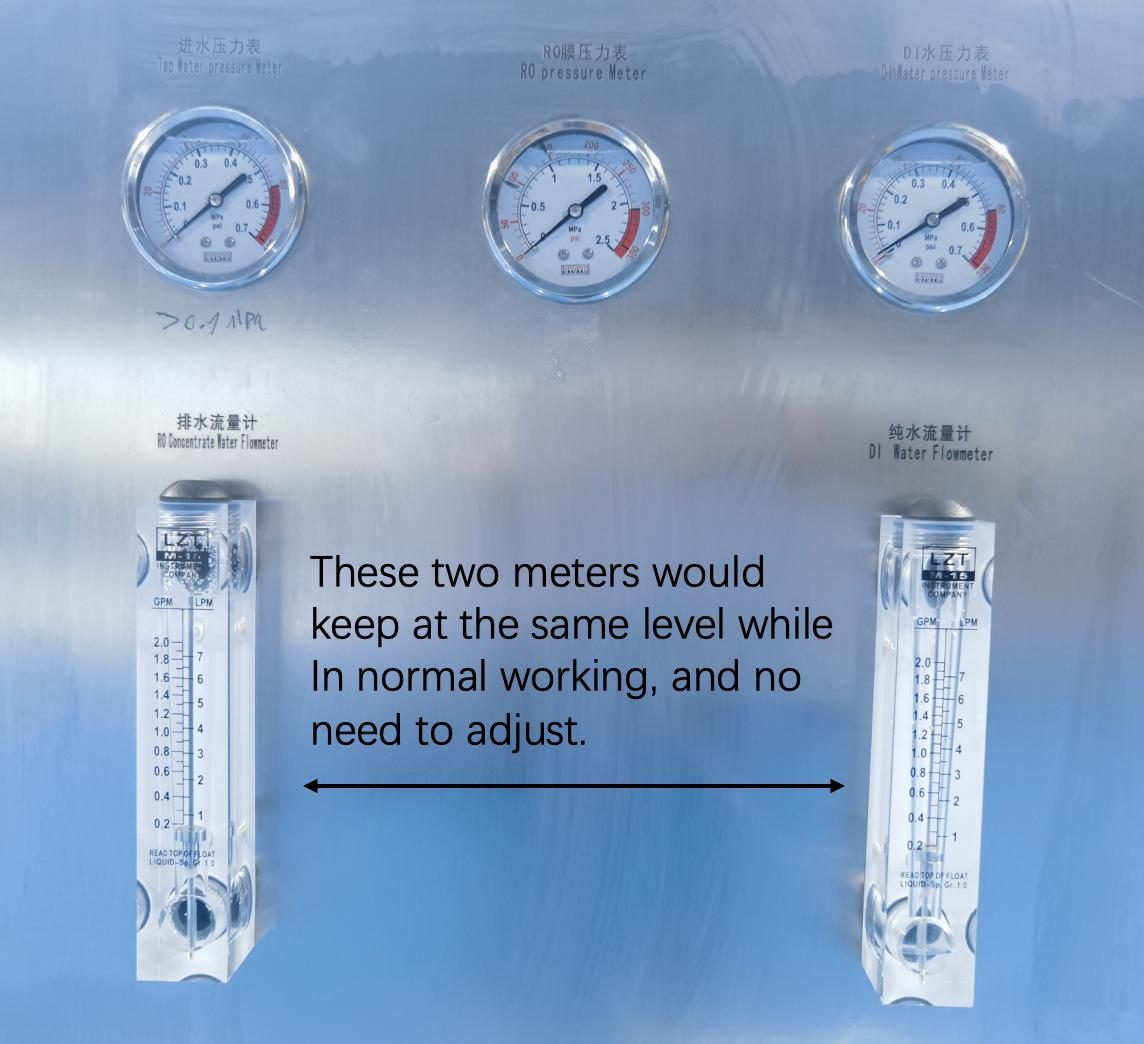
Three gauges across the top, two flow meters below. The document annotates this panel: "These two meters would keep at the same level while in normal working, and no need to adjust." Photograph from DI-1000 consumable materials issues .pdf.
Reading 3 - Conductivity: below 10
The conductivity monitor is the softening stage's instrument. The value should be below 10, and the document is specific about what a reading above that means: both the softening resin and the activated charcoal need to be changed.
That pairing is the useful part. A single bad reading is telling you about two consumables at once, because the carbon and the softener sit upstream of each other in the same pretreatment train and fail into the same symptom. Teams that change only the resin and reset the counter tend to see the reading come back within weeks.
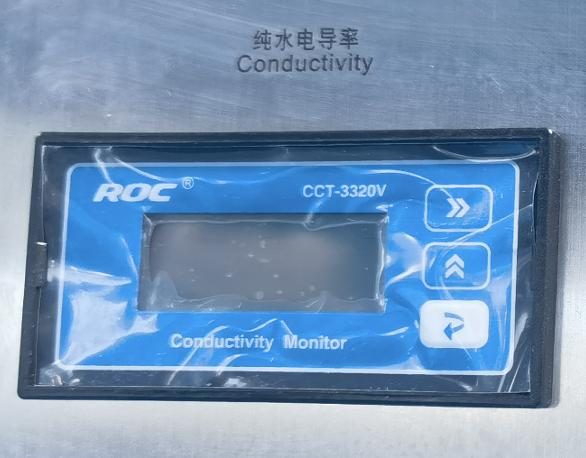
The conductivity monitor, labelled "Conductivity" on the bezel. Photograph from DI-1000 consumable materials issues .pdf.
Reading 4 - Resistivity: above 10, and only while the DI Pump on lamp is lit
The resistivity monitor is the last check before water leaves the machine, and it is the one most often misread. Two conditions are printed together in the document: the reading is only valid when the light of "DI Pump on" is on, and the normal value range is above 10 - otherwise the two tanks of polishing resin need to be changed.
The order matters. A resistivity figure taken while the pump is stopped is not a measurement of anything; it is a stagnant column of water sitting across two electrodes. Before anyone orders resin, the check is whether that lamp was lit when the number was written down. The mixed bed on this machine is a two-tank polishing stage, which is why the document names two tanks as the thing to change.
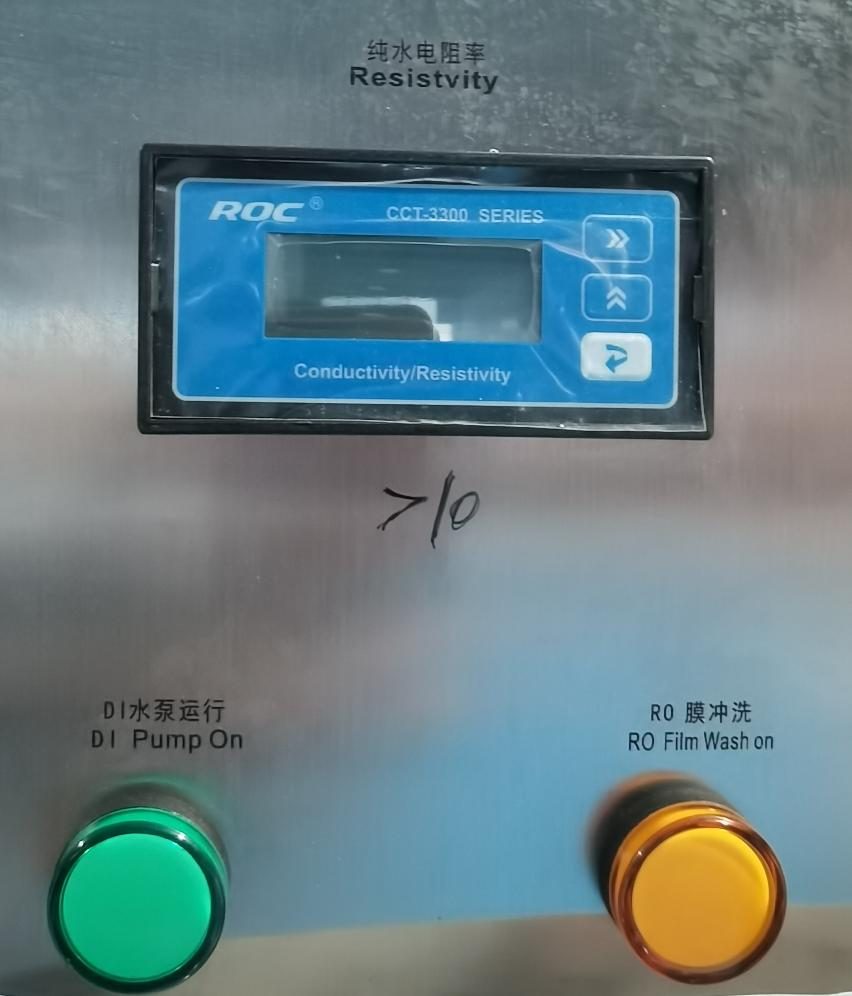
Resistivity monitor with the green "DI Pump on" lamp (left) and the yellow "RO Film Wash on" lamp (right). The handwritten ">10" on the panel is the threshold as read in the field. Photograph from DI-1000 consumable materials issues .pdf.
The two things on the panel you should not touch
Both are stated in the same document, and both prevent unnecessary work:
- The red valve does not need to adjust at anytime.
- The two flow meters keep at the same level while in normal working, and need no adjustment.
If a technician has been turning the red valve to "fix" a rinse problem, that is the first thing to put back and then re-measure.
Change intervals as published, by machine
The DI-1000 consumable document carries a full list with a suggested replacement time per item. Reproduced exactly as printed:
| S/N | Item | Spec | Qty | Suggested replace time | Source |
|---|---|---|---|---|---|
| 1 | Quartz sand | 0.5~16mm | 25kg | 6~12 months | DI-1000 consumable materials issues .pdf |
| 2 | Coconut carbon | 6~12 mesh | 50kg | 6~12 months | DI-1000 consumable materials issues .pdf |
| 3 | Softening resin | Cation resin | 75L | 6~12 months | DI-1000 consumable materials issues .pdf |
| 4 | Precision filter | 5um | 4pcs | 15~30 days | DI-1000 consumable materials issues .pdf |
| 5 | RO film | 40*40 | 4pcs | 6~12 months | DI-1000 consumable materials issues .pdf |
| 6 | Mixed bed rinse | Polishing resin | 75L | 3-6 months | DI-1000 consumable materials issues .pdf |
The same document also gives two cartridge intervals in prose, which are not the same thing as the precision-filter row above and should not be merged with it:
- The first stage of the filter cartridge (after the softening resin tank) needs to be changed every 15 working days.
- The last stage of the filter cartridge (after the polishing resin tank) needs to be changed every 45 working days.
The DI-250 manual publishes a parallel list, but it is a different machine with different quantities, so its rows are kept separate rather than averaged into the table above. Its cycle column is printed with corrupted text in the original document - cells read "8—12 unit/mon" and "8—12Polishing resin" - so only the unambiguous water-production figures are quoted here, and the month ranges are deliberately not reproduced:
| Item (DI-250) | Model as printed | Qty as printed | Water production before change | Source |
|---|---|---|---|---|
| Quartz sand | 0.5— | 25kg | about 50T | Industrial pure water machine (DI water generator) DI-250.pdf |
| Activated carbon | 6—12 | 12.5kg | about 80T | Industrial pure water machine (DI water generator) DI-250.pdf |
| Softening resin | cation | not stated | about 100T | Industrial pure water machine (DI water generator) DI-250.pdf |
| Precision filter | 1—5 | 2 unit | 7—15 days | Industrial pure water machine (DI water generator) DI-250.pdf |
| RO membrane | 40*40 | 2 unit | about 90T | Industrial pure water machine (DI water generator) DI-250.pdf |
| Mixed bed resin | Polishing resin | not stated | about 60T | Industrial pure water machine (DI water generator) DI-250.pdf |
Read the two lists together and the practical rule is obvious: the polishing resin is the shortest-lived consumable in the train (3-6 months on the DI-1000 list), which is exactly the consumable that reading 4 is watching.
Backflushing: only after you change carbon or softening resin
Backflushing is not a routine weekly task on these machines. The document restricts it: the "back flushing" only needs to operate after the activated charcoal and softening resin replacing, and before the first use. The two cannot be flushed at the same time - they are done one by one:
- Turn the valve on the top of the activated charcoal tank to back flushing, run the machine for about 30 mins, then turn the valve back to RUN.
- Then turn the valve on the top of the softening tank to back flushing, run the machine for about 30 mins, then turn the valve back to RUN.
- Back flushing is finished and the machine can start first use.
The DI-250 manual describes a separate routine for its multi-media filter - a flushing cycle of 1-2 times per week depending on local water quality, 15 minutes of flushing, then the positive punching position and a 10-minute rinse before returning the multi-way valve to running state. That is a different stage on a different document, and it should not be confused with the post-replacement backflush above.
What the machines are specified to deliver
The gauges only mean something against a design intent. The DI200 technical sheet is the most complete of the three, so its table is reproduced in full, with the source column dropped because every row comes from the same document.
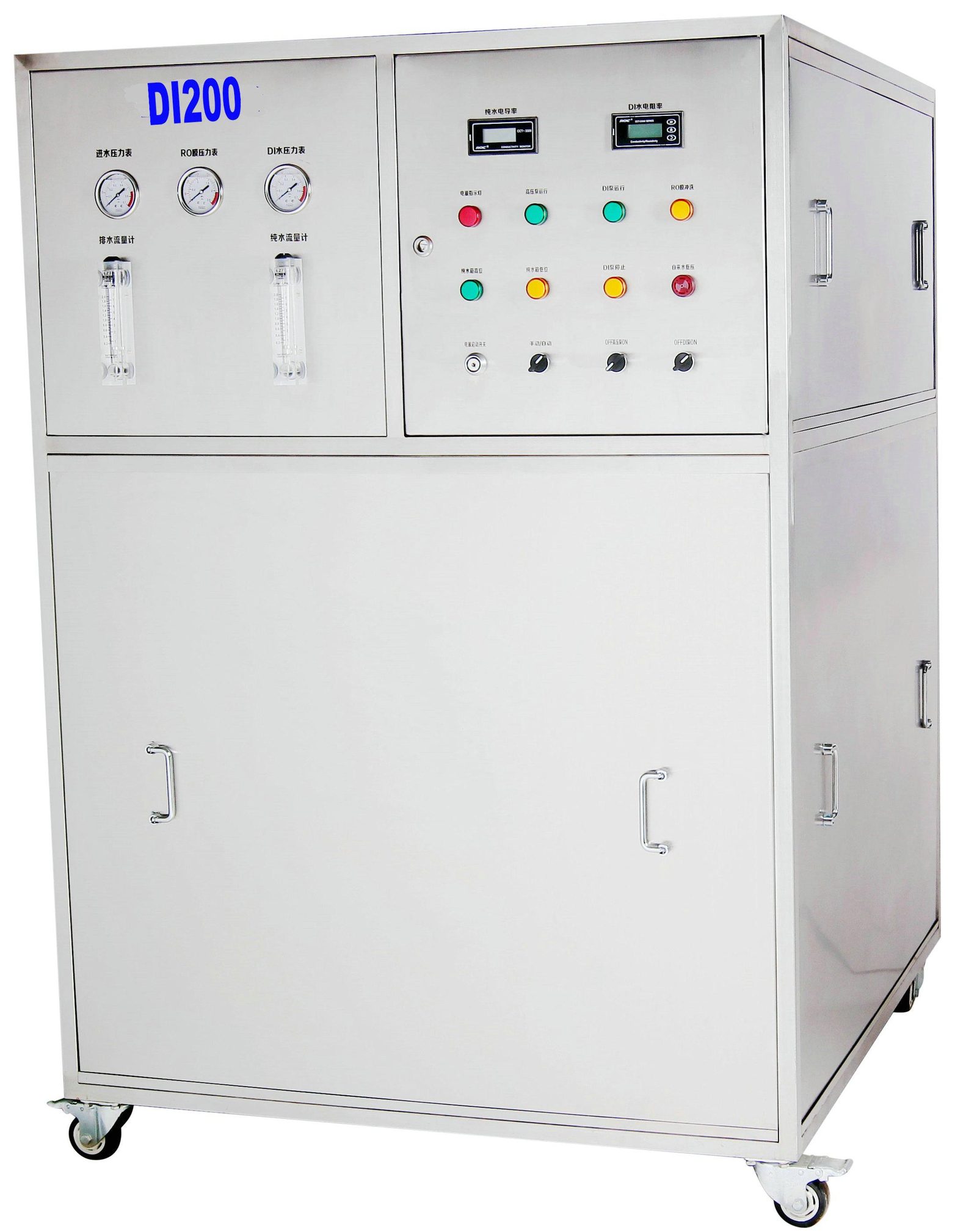
DI200 industrial DI water machine. Photograph from DI Water Machine DI200 Technical SPEC.pdf.
| S/N | Item | Technical Spec | Remarks |
|---|---|---|---|
| 1 | Tap water supply | 1.5T/Hour | |
| 2 | Tape water supply pressure | 0.2~0.3Mpa | spelling as printed in the source |
| 3 | DI water output | 200L/H | |
| 4 | DI water tank | 160L | 1pc |
| 5 | DI water resistivity | ≥10MΩ | |
| 6 | DI water pressure pump | 0.37KW | 1pc |
| 7 | Multi-material filter | 25L Quartz Sand+ Carbon | 1pc |
| 8 | Cationic softener | 25L cation resin | 1pc |
| 9 | Filter | 20inch 5um | 2pcs |
| 10 | High pressure pump | 1.1KW | 1pc |
| 11 | RO film | DOW40*40 | 1pc |
| 12 | MB polishing resin | 25L+25L | 2pcs |
| 13 | Power | AC380V,50/60HZ,2KW | |
| 14 | Machine size | L1100xW110xH1600mm | quoted verbatim; the W110 value is as printed and is queried with the product department |
| 15 | Weight | 400kg | |
| 16 | Material | SUS304 water tank, SUS201 frame |
Two more figures from the same sheet frame the consumption side. The machine's purpose is to "turn tap water into DI water and supply to our PCBA inline cleaning machine for DI water rinse after liquid cleaning", and its yield is stated as: determined by tap water quality, 50% of tap water will be turned into DI water and the rest 50% will be discharged to sewer. If your plant budgets water by DI output, that half-and-half split is the number to plan against.
The DI-250 is the larger sibling and its sheet is written as engineering narrative rather than a table. Its published figures: 250 liters of DI water per hour; a pretreatment standard effluent capacity designed to 1m3/h; RO desalination rate greater than 98%; terminal effluent resistivity reaching 10MΩ/CM for cleaning process water at 25°C; and terminal MB mixed bed water production of 0.5 ton/hour at normal temperature. The same document puts the RO unit's pure water recovery at generally only 50%-60% and requires the pollution index SDI before the host to be stable below 4, with its PP fine filter on a 5um pore size and a general replacement cycle of 1-2 months.
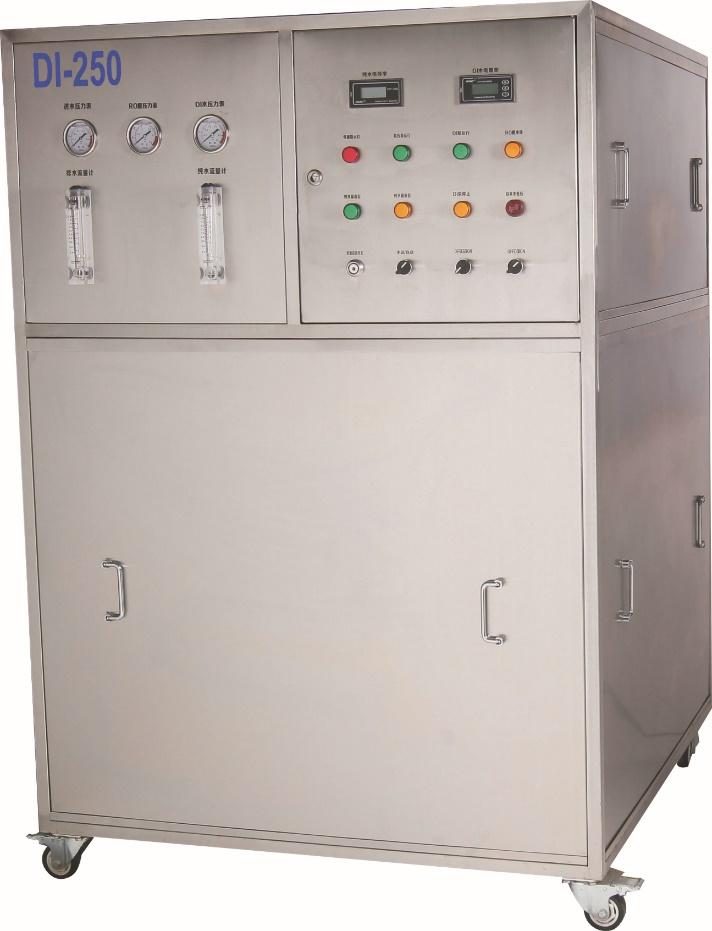
DI-250 industrial pure water machine. Photograph from Industrial pure water machine (DI water generator) DI-250.pdf.
Why an 18 MΩ figure you may have seen is a different number
Some Southern Machinery cleaning pages quote a resistivity figure around 18 MΩ. That is not a contradiction of the ≥10 MΩ outlet specification above, and the two should not be merged or converted into one another. The 0~18 MΩ figure is the measurement range of the on-line resistivity monitor fitted to the SME-5600D batch PCBA cleaning machine - an instrument span. The ≥10 MΩ figure is the water quality the DI machine is specified to produce - a process specification. One tells you what a meter can read; the other tells you what the machine must deliver. Confusing the two is how a plant concludes its water plant is underperforming when it is inside spec, or how a meter that cannot resolve high purity is mistaken for a pass.
See SME-5600D Batch-Type PCBA Cleaning Machine for the instrument span as published on that product's own page.
How the water train is arranged
The DI-250 document prints the process flow of the pure water system as a stage sequence. Written out, it explains why each of the four gauges sits where it does:
- Municipal tap water
- Front pressure pump
- Multi-media filter (quartz sand, coconut shell activated carbon)
- Cationic softener
- Precision filter
- High-pressure pump
- RO device
- Pure water tank
- DI water pressure pump
- Two-stage mixed bed
Read against the four instruments: the tap water pressure meter is watching the entry to step 1, the RO pressure meter is watching steps 6-7, the conductivity monitor is reporting on the pretreatment pair in steps 3-4, and the resistivity monitor is the final verdict on the mixed bed at step 10. A fifth stage - the DI200 sheet names it explicitly - is that the whole assembly is divided into a pretreatment system, an RO system and an MB (mixed resin bed) system.
Which cleaning machines these are paired with
The DI-250 document names its partners directly: it is an integrated deionized water generator that cooperates with the SCM5600D PCBA cleaning machine or the S-1688 steel mesh cleaning machine, supplying the rinse that removes residual solution and ions from the steel mesh after cleaning so that mesh cleanliness meets requirements. The DI200 sheet describes the same role from the other end - supplying a PCBA inline cleaning machine for the DI water rinse after liquid cleaning.
Pages on this site covering the machines that consume the water: SME-5600D batch-type PCBA cleaning, SME-6300 in-line PCBA cleaning, SME-750II stencil cleaning, S-1688 pneumatic stencil cleaner, S-6200 nozzle cleaning and SME-5200 pallet cleaning. For the wash side of the same argument - what to clean and when - see PCBA Cleaning After Wave Soldering: What and When.
Downloads - the three source documents
All three documents below are the official Southern Machinery sheets this article was written from. Local copies were byte-for-byte identical to the published copies on the product catalogue board at the time of writing (507,333 / 978,360 / 1,604,137 bytes respectively).
- DI Water Machine DI200 Technical SPEC.pdf - 16-row technical specification table
- Industrial pure water machine (DI water generator) DI-250.pdf - 12-page system description with process flow and consumables list
- DI-1000 consumable materials issues .pdf - the four gauge readings, change intervals and backflush procedure
Support terms as published
The closing page of the consumables document states the service terms verbatim: 7x24 Worldwide Support, Free Installation/ Training, 1 day lead-time (spare parts), and 1 Month customize solution. Those are the figures to hold a supplier to when a resin change is scheduled and the stock is not on the shelf.
To size a DI water machine against a specific washer, or to have an existing line's rinse quality reviewed, contact Southern Machinery.
What this article deliberately does not claim
- No labour-cost, payback or ROI figures. The staffing calculator referenced during topic selection was not available locally, and no monetary number is invented in its place.
- No video. The Southern Machinery video board was searched for DI water, deionized, pure water, RO membrane, resin, conductivity and resistivity content and returned no matching recording for this equipment; cleaning-machine demonstrations were not substituted, since they show a different product.
- No unit attached to the conductivity and resistivity thresholds, because the source prints none.
- No quantity for the DI-250 softening resin or mixed bed resin, and no month range from that document's corrupted cycle column.
- No claim that DI-1000, DI-250 and DI200 share consumable quantities - the three lists are kept in separate tables for exactly that reason.