
Quick answer: The S-400T is an automatic in-line PCB laser marking machine from Southern Machinery with a built-in board inverter. It marks the top and bottom of a board in one pass on an SMEMA line, locates with CCD plus fiducial Mark (±0.02 mm repeat accuracy), and reads each code back. It accepts boards from 50 × 80 mm to 450 × 400 mm, 0.8–4 mm thick, and can be built with a CO2, fiber, green or UV laser source. It suits factories that need permanent 2D-code traceability on PCBs without labels or ink.
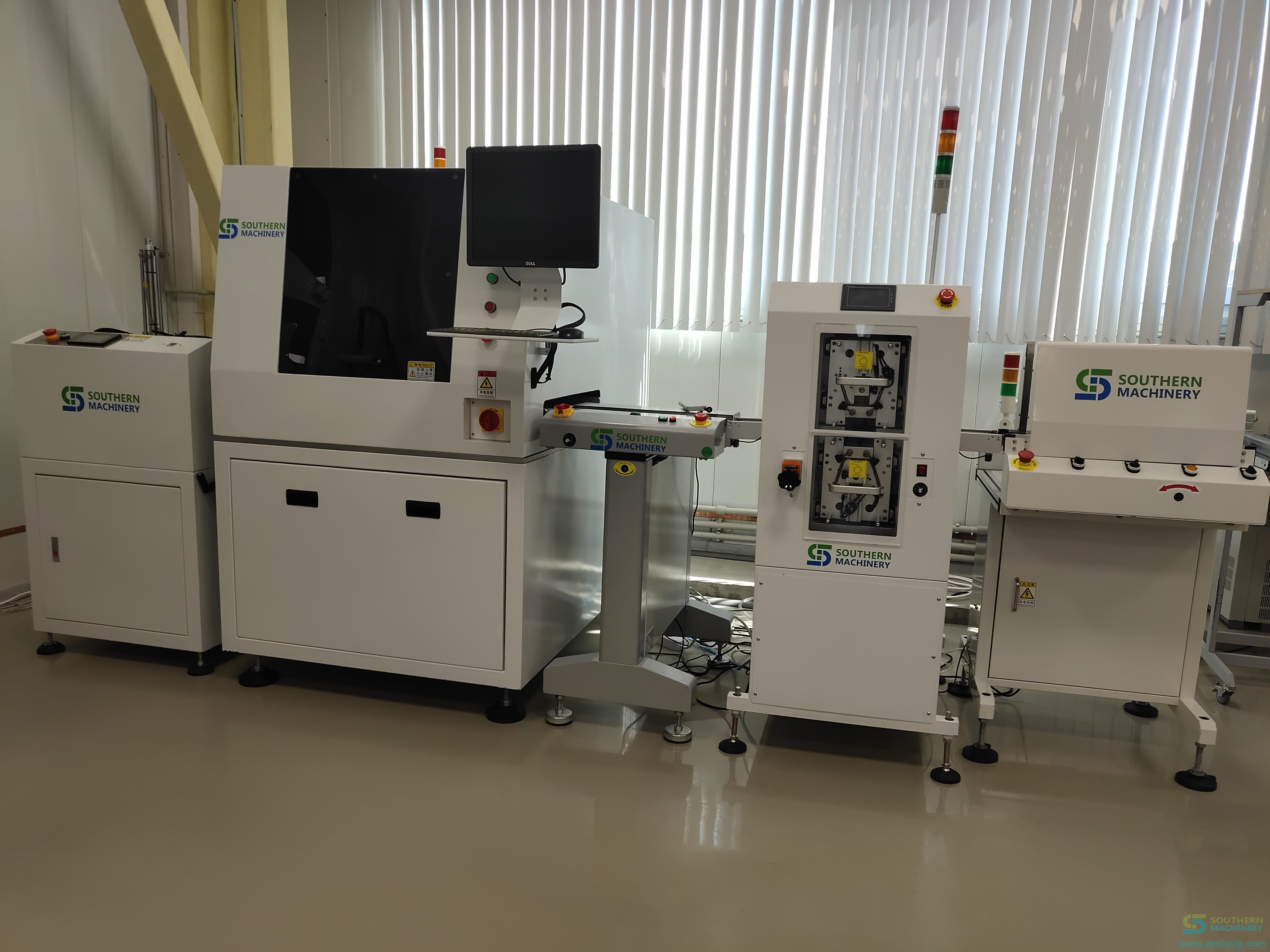
Why mark PCBs with a laser instead of labels or ink?
Per the manufacturer's product document, a printed label can fall off and has limited capacity, while inkjet codes have low precision and no permanence. Both add material to the board and carry consumable and handling cost. Laser marking changes the surface itself, so the code is part of the board and needs no consumables. The manufacturer reports no significant drop in code quality or readability after flux immersion, DI-water ultrasonic cleaning, silk-screen wash or wave soldering. Supported codes: PDF417, Data Matrix, Maxi Code, QR Code and standard 1D bar codes.
How does the S-400T PCB laser marking machine work?
- Board transfer in – the panel enters under SMEMA handshake; conveyor width adjusts automatically.
- Clamp and locate – CCD plus Mark fiducial recognition finds the true position.
- Read the existing code – the CCD reads any bar code already on the panel, enabling wrong-board checks.
- Engrave and verify side one – the laser head moves over a stationary board, then the CCD reads the new code back.
- Invert the board – the built-in reversal system presents the second face.
- Mark, verify, release – side two is marked and read back, then the board moves downstream.
What are the S-400T specifications?
Values below are quoted from the S-400T product document as published on the landing page.
| Item | Specification |
|---|---|
| Marking type | Dual-side, built-in PCB reversal system |
| Positioning | CCD + Mark fiducial; X/Y servo direct drive; repeat accuracy ±0.02 mm |
| Laser source | Optional CO2 / fiber (FAYB) / green (GR) / UV |
| PCB size | Min 50 × 80 mm, max 450 × 400 mm |
| Marking area per code | 1D: 2 × 6 mm; 2D: 1.5 × 1.5 mm (70 × 70 mm field optional) |
| Component clearance | 18 mm above and 18 mm below the board |
| Conveyor | Automatic width adjustment; height 900 ± 20 mm; left-to-right (right-to-left optional) |
| Communication | SMEMA; link to SHOPFLOW, IMS, MES |
| Recognition | Online code reading; opposite/reversed/wrong-board recognition; bad-mark "X" skipping (optional) |
| Power / air | AC 220 V, 16 A, 50/60 Hz / ≥ 0.5 MPa |
| Size / weight | 1000 × 1600 × 1700 mm / 700 kg |
| Environment | 0–40 °C, 35–85 % RH, no condensation; forced-air cooling, no water chiller |
Two source-document rows need confirmation before quoting: the board-thickness row prints as "0.8-C4 mm", and the CO2 source-life row differs between documents. Ask us to confirm both.
Which laser source should I choose?
The manufacturer publishes a comparison. CO2 (10.6 µm) suits larger boards where marking requirements are modest; marks can yellow or blacken. Fiber (1064 nm) is only partially suitable and needs a sample test. Green (535 nm) and UV (355 nm) are listed as suitable for all PCB solder-mask layers, with green offering the highest precision and strongest adhesion and UV slightly lower precision. Focal length options are 70, 110 or 190 mm. A sample test on your own board is the reliable way to decide.
How many boards per hour can it mark?
The manufacturer's worked example: a 330 × 250 mm panel with one 2D code takes 3–4 s to load, 1 s for the fiducial, 0.5 s to engrave and 1 s to check, so 5–7 s per board, about 600 boards per hour. More codes or a second side lengthen the cycle. A customer acceptance report on a UV source recorded a 100% success rate on 6 × 6 mm, 23-digit QR codes.
What should you send for a quotation?
- Board size, thickness and solder-mask colour
- Code type, content length and number of codes per side
- Target takt time
- Line direction and SMEMA interface details
- MES / SHOPFLOW / IMS connection needs
FAQ
Can the S-400T mark both sides of a PCB?
Yes. A built-in reversal system turns the board and marks the second face in the same in-line pass.
Does it need a water chiller?
No. The specification lists forced-air cooling and no water chiller.
Can it connect to our MES?
The product document lists access to SHOPFLOW, IMS, MES and customised management systems.
Does it check the code after marking?
Yes. The CCD reads the fresh code back; an optional bar code grade analysis system is available.
See the full product page
Full details, gallery and videos: S-400T Automatic PCB Laser Marking Machine product page.
Send us a board for a marking test: info@smthelp.com · WhatsApp +86 136 0256 2576.